
Enterprise Networks have become essential to the operation of companies, laboratories, universities, and government agencies. As they continue to grow both in size and complexity, their security has become a critical concern. Vulnerabilities are regularly discovered in software applications which are exploited to stage cyber-attacks.

What’s their Need?

The network of the modern enterprise is a combination of local and cloud infrastructure. The users are distributed in the ones who use it from office network and the ones who are accessing the same remotely. A policy structure is the best practice implemented in offices based on experiences and industry standards to ensure the security and uptime of the system.

A good enterprise policy secures the network, allocates the speed according to the task/requirement and logs this for audit purposes.

Difficulties to Achieve the Need

Enterprise Networks of today have become more
challenging and the requirement of constant uptime
gives the IT Admin few chances to enforce and upgrade
the network.

The need of the day is a flexibility to enforce Enterprise
Policies that lend security to the network like keeping
the resource usage optimum.

Trusted by the world's leading companies

Company Logo
Company Logo
Company Logo
Company Logo

The Solution

  • Groups in Ray are a flexible way to create a logical segregation of user devices. The groups can be created based on wide definitions like Employees and Guests or more common implementations like the Finance Team, Sales Team, HR Team, Admin Team etc.
  • For each of these groups, Ray allows you to create policies that help to enforce the compliance required as per business rules or industry standards.
  • The Content Policy in Ray enables the IT Admin to apply the policies on the Internet content. The content policy further provides the below.
  • The web is divided into categories of domains like News, Social Media, Porn, Crime Sites, Peer to Peer, etc. The IT admin can choose the domains to restrict for the given group of users.

Time Policy

  • The Time Policy enables the IT admin to control the time at which the user can access the Internet. E.g. A user can be restricted to access the internet on the weekdays.
  • The Speed Policy enables the IT admin to fairly allocate the precious bandwidth resource. The Speed Policy can be applied as absolute speed or as priority of the device traffic on the network.
  • The Device Policy enables the IT admin to limit the access of the network or SSID to a certain type of device. For e.g. The Company Enterprise SSID is limited only to Windows devices and Android and IOS devices are restricted to access the same.
  • Configuring tailored ads to ensure a better click-through rate. Measuring, analysing, and optimising the impact of each communication.
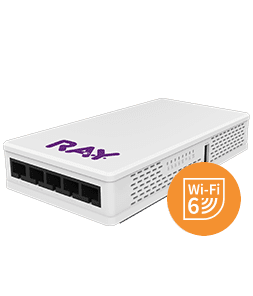
  • The Ray Wi-Fi access point is the first network node from where the traffic goes to the network and eventually to the Internet. The Firewall on the Wi-Fi can be used to restrict certain IP Addresses, Ports, or a combination.
  • Ray provides the IT Admins the capability to enforce the BYOD Policy. The user’s device when used first time or on recurring basis can go through an approval process before Internet or Intranet access is provided.
  • Personal devices or non-approved devices plugged into the Wi-Fi can be stopped from entering the Intranet or Internet or both.

The Benefits

  • Granularize Policies per Individual, Group or SSID
  • Enforce Time, Speed, Quota & Content Policies
  • Enforce BYOD policies
  • Enforce Firewall rules at the Wi-Fi level
  • Categorize traffic into High, Medium & Low
  • Layer 7 application Control and Shaping

Other Platform Highlights

  • SOT - security of things
  • Eye
  • Guest Wifi /captive portal
  • Intelligent RRM

Additional Resources

  • Blogs

Cater to your home & office needs and learn about
each one’s apt Wi-Fi usage. Like it and want it?

Our Sales Team would love to help you.

Contact Sales