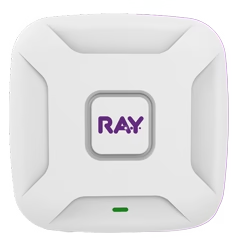
Ray’s R6A-C is a dual-band, Cloud-managed Wi-Fi 6 (802.11ax) access point with 2X2:2 MU-MIMO, OFDMA and 1024 QAM.
With a speed of 1800 Mbps this high density indoor wireless access point is an ideal fit for deployments in offices, schools, hospitals, shops, and hotels and cater to the most demanding of uses—including high-density deployments and bandwidth or performance-intensive applications like voice and high-definition video.
Ray R6A-C offers high throughput, enterprise-grade security, and simple management through the Ray ONE..





Proving the Moore’s perception that the number of transistors on a microchip doubles every two years, though the cost of computers is halved is right, the computational capabilities of wireless access points are increasing.
Ray has focused to ensure the decrease of overall TCO and increase in the lifetime value of a Ray wireless access point for the enterprise.
Ray has achieved this by opening the Ray operating system to application developers. This has led to apps like SD-WAN, VPN, attendance management, employee productivity etc. to be available on the Ray Application Store.
These apps are tested for their security, privacy, and performance against the stringent policies of Ray.
The SaaS nature of the application store ensures overall affordability whilst bringing extensibility to the Ray ONE.
Ray’s wireless access points are extremely ISP focused and have been designed keeping their struggles in mind.
The prices of internet are going down while the costs of providing high quality service are increasing. On one hand the Truck Rolls, high Installation Costs and increasing Service Costs are driving the ISP costs higher and on the other hand, poor quality of experience and slow response to complaints are driving the customers to churn out.
Ray’s ChurnAlert uses Machine Learning to monitor 33 datapoints of CRM and Ray ONE to predict the customer Quality of Experience (QoE) and thereby the probability of customer churn from the ISP. These data points put the ISP on a front foot to provide proactive support whilst reducing the Truck rolls and reducing operation costs by 30% to 50%.
The 100% API availability and pre-defined integration points enable Ray to integrate with ISP BSS backend and provide a single unified platform for customer enablement and support.

The API contains a set of tools known as endpoints for building software and applications that extend the Ray application data and statistics to enterprise applications or dashboard.
Ray has been true to the principle of being open by providing 100% API coverage. The API is very well documented and available via the support portal of Ray.
All the API are modern and RESTful and use HTTPS requests to access and use data. The data is provided in a JSON human-readable format.

Enterprise networks of the day serve mission critical functions. Insights might be required at the middle of the night or during travel or even vacation.
Ray extends the cloud controller via the Ray Mobile Application to enable visualization of the enterprise network and all the key KPI from anywhere and anytime.
The Ray mobile app also provides real-time notifications and alerts to the IT Admins keeping them in loop with all network activities.
The Ray mobile app is available for both Android and IOS ecosystems ensuring full coverage.

he growth in connected devices and streaming services that rely on Wi-Fi connectivity has resulted in the need for smarter Wi-Fi networks that provide extended, uniform coverage across places that have no wired connectivity.
Ray uses Wi-Fi Alliance certified Wi-Fi EasyMesh and Qualcomm Wi-Fi SON to employ multiple access points that work together to form a unified network that provides smart, efficient Wi-Fi throughout the indoor and outdoor spaces.
The easy setup delivers automatic device onboarding and configuration while the flexible design allows for best placement of multiple APs providing extended courage.
The Ray wireless access points are self-managing and self-optimizing. It collects network information and responds to changes in the network conditions to maximize performance.
The Ray wireless access points use effective load balancing to guide the devices to roam to the best connection and avoid interference.
Several Ray access points use a dedicated 3rd Radio to provide Mesh wireless backhaul thereby increasing the Mesh performance.

Wireless Networks or Wi-Fi is the most preferred connectivity option for devices and things. It is also the preferred method used by hackers to hack into the enterprise network and steal sensitive data or to implant malware costing businesses millions in revenue loss along with loss of customer and market respect.
The most well-known Wireless attacks are Rogue AP and Evil Twin attacks.
Ray wireless access point creates a trusted and safe Wireless Environment by doing continuous and proactive RF scans while ensuring optimum wireless performance. Whenever it detects a Rogue AP or Evil Twin, a notification is sent to the IT Admin to ensure the same is mitigated.
60% of security breaches are caused due to human error. Ray enforces best practice templates in configuration to reduce the chances of misconfiguration or weak wireless configuration.

raditional enterprise wireless solutions are controller based or based on first generation cloud which are expensive to scale and difficult to manage. The roll outs of new features are slow as they are not equipped for the modern-day enterprise which demands intelligence, reliability, and performance from its network.
Ray’s cloud is microservices driven and architected on the enterprise stream processing platforms performing real-time data streaming. The deployment on Amazon Web Services (AWS) ensures multi-availability zone (AZ) ensuring high availability for mission critical enterprise networks.
The powerful cloud enables Ray to provide the most intelligent AI engine to drive features like EYE, Insights, ChurnAlert and Vigil taking network security, automation and user engagement to the next level.
End to End 256-bit encryption ensures security and privacy of enterprise data.
Ray has strived to ensure simple and engaging user experience via intuitive UI design that reduces the learning curve whilst providing all the features expected of an Enterprise-grade Wireless Access Point.

The EYE focusses on two Network KPIs important to an Enterprise. One is to give a stellar Wi-Fi user experience and two is to minimize IT support costs.
To provide a Wi-Fi experience that is quantifiably good, the key service-level thresholds such as time to connect, capacity, coverage, throughput, and uptime must be visible and measurable. KPI can then be set on these parameters to understand their adherence.
To minimize IT support costs, Ray plays a two-part role. Based on the inputs, firstly the system proactively optimizes performance and can prioritize applications, resources, and users without any manual intervention. Secondly, the AI driven anomaly detection automates triggers to capture wireless and wired packets. These are fed into the event correlation engine to build a platform that acts as your in-house IT 24X7.

Ray’s outdoor wireless access point are made from industrial-grade components and are certified for IP67* rating. This makes the wireless access points highly resistant to temperature and weather conditions and ensure optimal performance even in adverse conditions.
These help to extend Wi-Fi outdoors by providing a highly scalable coverage to deliver solid connectivity even in rugged and hazardous locations.
The external antenna extends coverage providing great throughput.
The dedicated 3rd radio in several Ray outdoor wireless access points provides wireless connectivity in hard to reach places without need of a wireline internet connection.

Ray enables enterprises to build a custom Wi-Fi experience by creating elegant, responsive, mobile-friendly captive portals with Ray’s built-in customizable templates which are multi-lingual, responsive and require zero coding. The captive portals can be customized as per your Brand name, colours, etc. and help in making a brand visible.
The built-in targeting engine gives a personalized option driven by location, user device, engagement ratio and other audience metrics.
Ray bundles Advertisement server, which delivers campaigns to a captive audience with targeted static and dynamic picture and video content.
Ray Survey Engine adds surveys for deep visitor understanding and engagement.
The Analytics Dashboards provides actionable insights like impressions, clicks, survey data, user location, dwell time etc.
The Ray Captive Portal has built in AAA (Radius) and advance plan management to make it a complete solution. It can also connect to external Captive Portals.
The Built-in Security Rules and Network Policies ensure that the guest network is isolated from the Enterprise Network.
Ray complies with country specific norms for storage of IP logs.

Industrial IoT (IIoT), Enterprise IoT and Home IoT are witnessing a boom. The industrial IoT market is expected to grow at a CAGR of 16.7% from 2019 to 2027 to reach $263.4 billion by 2027. With IoT taking a centre stage and machines surpassing the humans, the security landscape changes from endpoint security to Security of Things (SoT).
Since most IoT devices use Wi-Fi to connect to the internet, Ray’s Cloud-managed wireless access point is at a strategic place to provide Security of Things (SoT) without any agent or network scanning.
Ray has a pre-built library of 1000s of IoT devices and it keeps growing. Ray uses Machine Learning (ML) to provide Real-time & continuous Vulnerability Assessment of IoT devices.
SoT security is a must in today’s times. The Security of Things (SoT) is when the daily physical devices are connected digitally and are embedded with internet connectivity sensors. The communication and control of these devices happen via the web. Data is transferred over a network via these devices and security of the data as well as the device is the primary concern.
With Machine Learning (ML), Ray takes responsibility of the security aspect and has an SoT library of 1000s of devices providing auto-learn signatures. In case of mishaps, Ray access points are notified with SoT anomaly detection and alerts. Upon threat detection, SoT can respond via Network Disconnect or Network Quarantine of the IoT device.
| HT20 | HT40 | VHT20 | VHT40 |
|---|---|---|---|
| MCS0 | MCS0 | MCS0 | MCS0 |
| MCS0 | MCS0 | MCS0 | MCS0 |
| HT20 | HT40 | VHT20 | VHT40 |
|---|---|---|---|
| MCS0 | MCS0 | MCS0 | MCS0 |
| HT20 | HT40 | VHT20 | VHT40 |
|---|---|---|---|
| MCS0 | MCS0 | MCS0 | MCS0 |












💬 Leave a Comment
Share your opinion, comment, rate, and share your thoughts.